


Why Identity-Only Access Is Incomplete
A valid username and password do not guarantee a secure session.
Attackers frequently:
- Use stolen credentials from foreign regions
- Attempt logins from unknown or unmanaged devices
- Leverage anonymized networks and rotating IP infrastructure
- Exploit compromised or non-compliant endpoints
Without contextual enforcement, access decisions rely on incomplete trust evaluation.
Modern identity security requires continuous contextual validation — not identity alone.
The Architectural Need for Conditional Access
In hybrid and multi-cloud environments, organizations must evaluate:
- Is the device recognized and compliant?
- Is the login originating from an approved geographic region?
- Is the network behavior consistent with expected patterns?
- Does user activity align with normal behavior?
Static access policies cannot adapt to dynamic workforce mobility.
Access decisions must be contextual, adaptive, and continuously evaluated.


The Rainbow Secure Approach
Rainbow Secure enforces Device & Location-Based Access Control through:
- Trusted device fingerprint recognition
- Geographic and network policy enforcement
- Context-aware dynamic risk scoring
- Adaptive authentication escalation
- Continuous session trust validation
If login conditions fall outside defined policy boundaries, access is denied or step-up authentication is triggered.
Even when credentials are technically valid, plain password text is ineffective without meeting device and location trust policies.
Trusted Device Profiling
Identifies and enforces policies based on known and approved device characteristics.
Geographic Access Policies
Restricts, challenges, or denies authentication from unapproved or high-risk regions.
Risk-Based Conditional Enforcement
Strengthens authentication requirements when device or location signals deviate.
Adaptive Policy Escalation
Dynamically increases verification under elevated contextual risk.
Continuous Trust Monitoring
Re-evaluates device posture and geographic consistency during active sessions.


How It Works
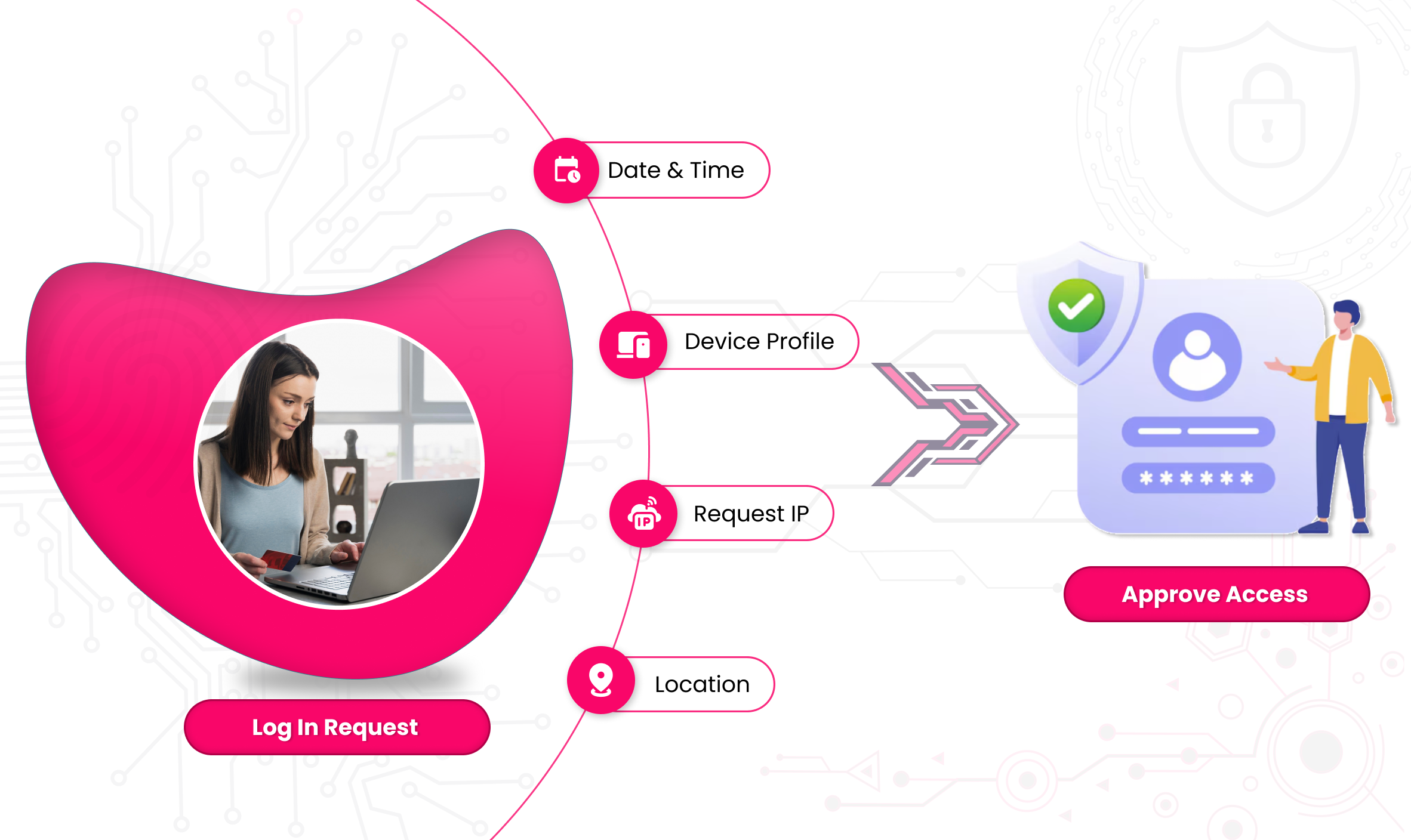
- User initiates login
- Identity authentication is validated
- Device fingerprint and geographic signals are analyzed
- Risk engine calculates contextual trust level
- Policy determines allow, deny, or step-up authentication
- Session trust is continuously monitored post-login
Access is granted based on contextual intelligence — not assumption.
Architectural & Business Benefits
Implementing device and location-based access control enables organizations to:
- Reduce exposure from stolen credentials
- Prevent foreign and anomalous login abuse
- Secure remote and hybrid work environments
- Restrict unauthorized or unmanaged device access
- Strengthen Zero Trust maturity
- Support regulatory and audit requirements
Access becomes contextual, adaptive, and defensible.


Designed for Cloud-First Enterprises
Rainbow Secure integrates with:
Conditional access enforcement is implemented without infrastructure redesign.
- Microsoft 365 & Entra
- Okta and Other IAM Platforms
- Custom and legacy systems
- Google Workspace
- SaaS applications
Move Beyond Password-Based Trust
Trust must be established through context.
Enforce structured, policy-driven access decisions grounded in device intelligence and location validation.
Request a Demo Speak with a Security Architect


Assume credentials will be compromised

Do not rely on user awareness alone

Do not break during peak transaction spikes

Reduce fraud losses and investigation fatigue